

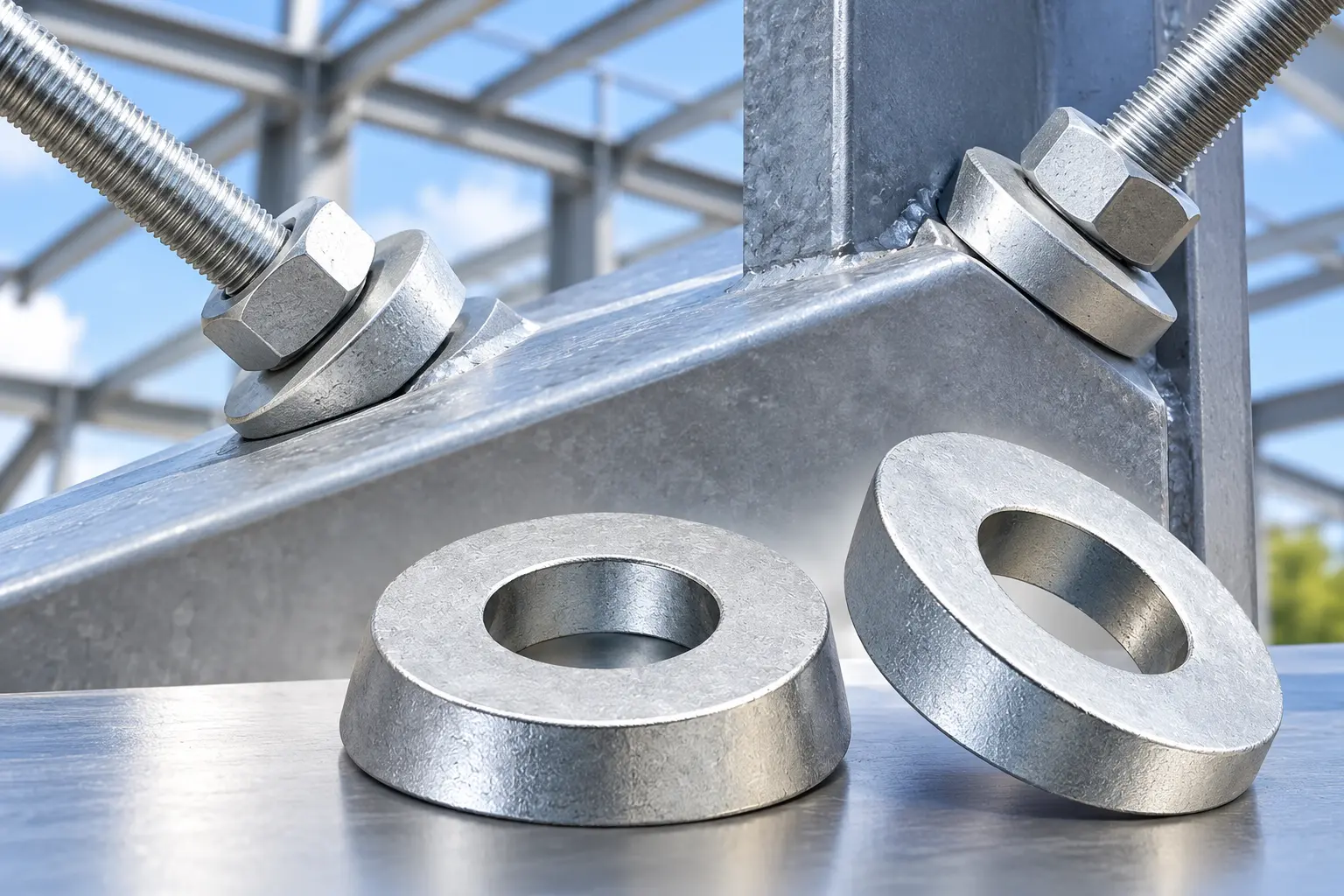
A hillside washer looks like a mistake. One face is flat, the other is cut at a slope, and the hole through the middle is oversized. Next to a standard washer it appears crudely made.
It isn’t. Every one of those features is solving a specific problem — and the sloped face is a deliberate cutting and machining operation, not a rough edge. Once you understand what the problem is, you start noticing where a hillside washer should have been used and wasn’t.
The problem it solves
Washers exist to spread load and give the nut a flat surface to bear against. That works perfectly when the rod runs square to the surface it passes through.
Plenty of structural connections are not square. A roof brace runs diagonally across a sloped rafter. A sag rod passes through a purlin web at an angle. A tie rod anchors into a face that isn’t perpendicular to its line of pull. In all of these the rod arrives at the member at an angle, and a flat washer has nowhere flat to sit.
What happens next is the failure mode. The nut and washer bear on one edge rather than across the full face. Load that should be axial in the rod becomes bending at the thread. Bearing pressure concentrates on a small area of the member. The assembly can be torqued up perfectly and still be loading the rod in a way nobody designed for — and the thread at the nut face is exactly where a rod under bending tends to fail.
A hillside washer removes the angle. The sloped face matches the member’s surface, the flat face gives the nut a square seat, and the oversized hole lets the rod pass through at its working angle without binding. The rod stays in tension, which is what it was sized for.
Where they are used
Roof bracing in pre-engineered buildings
This is the most common application by some distance, and it turns up on almost every structural steel fabrication job with rod bracing. Bracing in a roof plane runs diagonally and meets purlins and rafters at angles that vary across the building. Hillside washers let one standard rod and nut arrangement work across those varying angles. They sit naturally alongside brace rods, brace rod connectors and sag rods in a pre-engineered building fastener package.
Sag rod connections
Sag rods run between purlins to control deflection and twist. On a pitched roof the geometry means the rod rarely meets the purlin web square, so the washer takes up the difference and keeps the rod loaded axially.
Sloped and uneven concrete
Foundations on graded sites, retaining walls and sloped plinths all present faces that are not perpendicular to the bolt. A hillside washer lets an anchor bear properly against a surface it does not meet at ninety degrees.
Steel framework and machinery mounting
Anywhere a threaded rod or bolt passes through an inclined member — angled bracing, cross-bracing in towers, equipment mounted on a sloped base — the same geometry problem appears and the same component solves it.
Why the hole is oversized
This confuses people who assume a loose fit is sloppy manufacturing.
The hole has to be larger than the rod for two reasons. First, the rod passes through at an angle, so the effective opening it needs is wider than its own diameter. Second, fabricated steelwork has tolerances, and a rod arriving at a bolt hole a few millimetres off its theoretical line still has to pass through and be tightened without being forced. The clearance is deliberate.
What the oversized hole does not mean is that the washer accepts any angle. The bevel is cut to a specific slope, and it needs to match the surface it bears against. A washer beveled for one pitch, used on a different one, reintroduces the problem it was bought to solve — just less obviously.
What to specify
A hillside washer is a small, cheap component that is easy to get wrong because it is usually ordered as an afterthought. Four things need stating:
- Rod or bolt diameter it serves, so the hole is sized correctly for that diameter at the working angle
- The bevel angle, taken from the geometry on the drawing rather than assumed from a standard pitch
- Material — mild or carbon steel, or stainless such as SS 304 or SS 316 for exposed and coastal work
- Finish — plain, hot-dip galvanised, zinc plated or painted, matched to the rods and connectors it will sit against
That last point is worth a moment. Pairing a plain washer with galvanised rods puts two dissimilar surfaces in contact at exactly the point where water collects. Match the finish across the whole assembly rather than ordering the washers separately and later.
Because these are made to order rather than pulled from stock, the bevel can follow the actual geometry on your drawing. That is the advantage of custom metal fabrication over buying a generic part and hoping the angle is close enough. At E S HAJI & CO there is no minimum order quantity, so a project needing forty washers at one angle and sixty at another is a normal enquiry rather than a problem.
A note on ordering the whole assembly together
Hillside washers rarely fail on their own. What fails is a bracing assembly where the rod came from one supplier, the connectors from another and the washers from a third, and nothing quite matches — the bevel is close but not right, the finishes differ, the hole is sized for a different rod.
Ordering rods, connectors, sag rods and washers from one manufacturer against one drawing removes that whole class of problem. When the threading on the rods and the bevel on the washers are produced in the same works to the same drawing, they fit. It also means one Mill Test Certificate set covering the batch, rather than three partial records.
Frequently asked questions
What is the difference between a hillside washer and a bevelled washer?
The terms are often used interchangeably in practice. Both describe a washer with a sloped face for angled connections. “Hillside washer” is the more common term in structural steel and pre-engineered building work, particularly for rod bracing.
Can I use two flat washers instead?
No. Stacking flat washers does not create a square seat for the nut — it just moves the same edge-bearing problem further along the rod. The sloped face is the entire function of the component.
Does the bevel angle have to match the surface exactly?
It should match the geometry on the drawing. A small mismatch reduces how effectively the washer squares up the nut, and a large one defeats the purpose. Take the angle from the drawing rather than assuming a standard roof pitch, which is why these are better made to order than bought generically.
Which side faces the steel?
The sloped face bears against the inclined member; the flat face takes the nut. Fitted the wrong way round the washer provides no benefit at all, and it is a genuinely common site error worth checking during erection.
Do you supply hillside washers with matching rods and connectors?
Yes. At E S HAJI & CO brace rods, brace rod connectors, sag rods and hillside washers are all manufactured in-house to the same drawing, in a matched finish, with a Mill Test Certificate issued per batch and no minimum order quantity.