

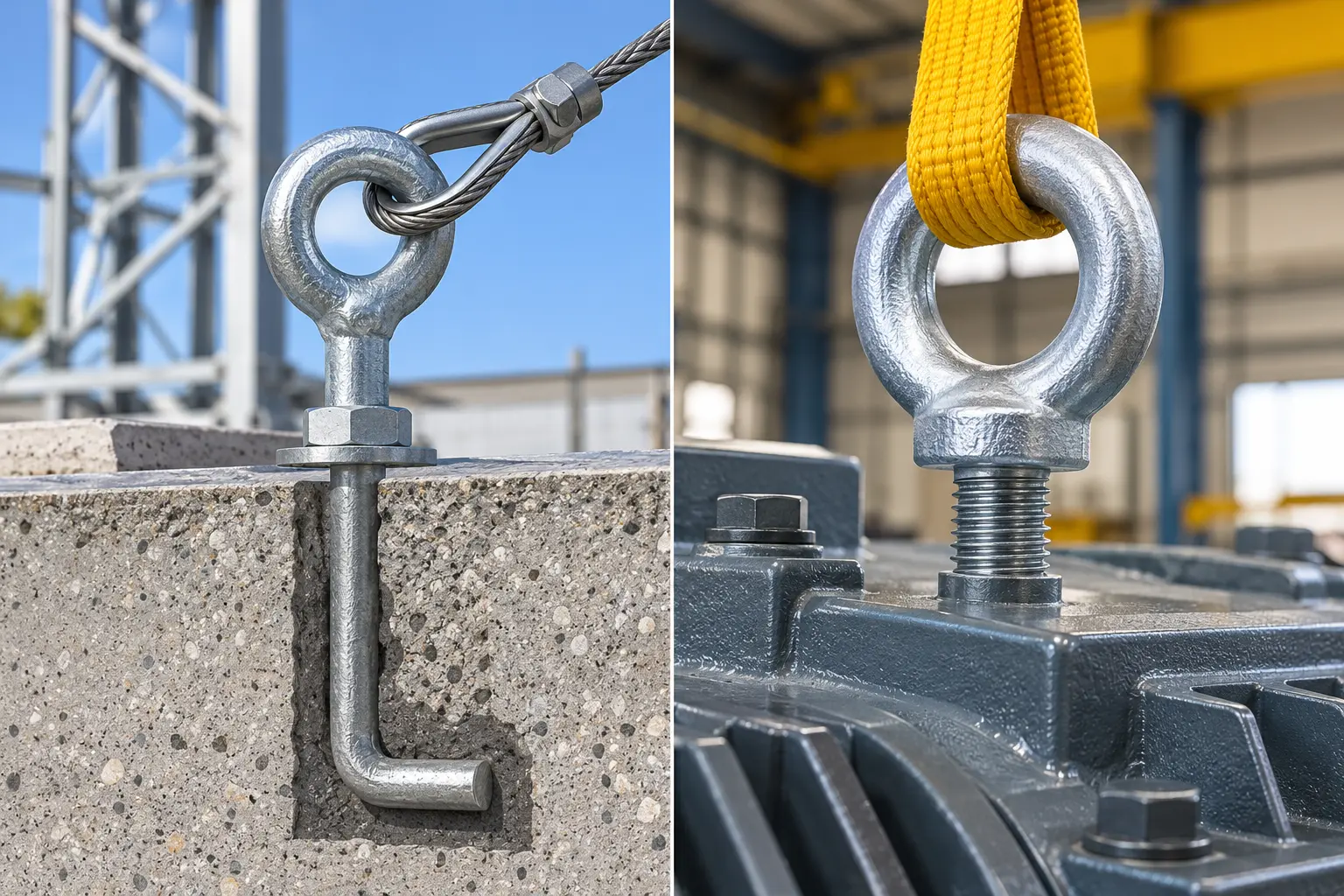
Two parts share the name “eye bolt” and they are not interchangeable. One is cast into a concrete foundation to anchor a structure. The other is screwed into a machine and used to lift it. They look broadly similar, they sit in the same bin on plenty of sites, and confusing them is one of the more dangerous mistakes available in industrial procurement.
If you are specifying either, the distinction is worth ten minutes of your attention — particularly on a structural steel fabrication package where both products can appear on the same site.
The anchoring eye bolt
An eye foundation bolt is a structural anchor. One end is embedded in concrete, the other end carries a looped or forged eye that projects above the surface. The eye is there to receive something flexible — a guy wire, a stay cable, a tie-down, a turnbuckle, a chain.
You see them on mast and tower guying, on equipment tie-downs, on conveyor and chute restraints, and wherever a cable has to terminate into a concrete base. Like any foundation or anchor bolt, the embedded portion does the real work, and the profile below the surface can be straight, hooked or plate-ended depending on the embedment available and the load case.
The important characteristic is this: an anchoring eye bolt is specified by the structural drawing. Its diameter, grade, embedment and eye dimensions come from the design, and its capacity is established by the designer in the context of the concrete it sits in. It does not arrive with a rating stamped on it, because its capacity is not a property of the bolt alone.
The lifting eye bolt
A lifting eye bolt is a different category of product entirely. It is a lifting accessory, usually forged, with a short fully threaded shank and a shoulder, and it screws into a tapped hole in the equipment being lifted. The thread runs the full length of that shank, which is part of how it is designed to seat.
The governing standard most commonly referenced is DIN 580, which specifies the properties of steel and stainless steel eyebolts and how they are correctly used in lifting operations, whether as part of a sling or as load-handling equipment. Crucially, it arrives with a Working Load Limit, and that WLL is established against a defined safety factor — typically a minimum breaking load of six times the WLL.
DIN 580 eye bolts are also primarily intended as permanent attachments on equipment rather than as general-purpose rigging hardware moved from job to job.
The detail that catches people out: angular loading
This is the part most buyers do not know, and it matters more than the thread size.
A lifting eye bolt’s rated capacity applies to a vertical, axial pull. Pull at an angle and the rating drops sharply. For a standard DIN 580 carbon steel eye bolt, an M24 is rated around 1,800 kg in straight axial lift, but at a sling angle between 0 and 45 degrees that falls to roughly 1,290 kg, and between 45 and 60 degrees to around 900 kg. That is half the capacity gone, with nothing about the bolt having changed.
DIN 580 also requires that the eye bolt be fully screwed in, achieving firm contact between the two mating faces. A bolt left standing proud of its seat is loaded in bending rather than tension, which is not how it was rated.
So a rigger who reads “M24, 1.8 tonne” off a chart and slings at 50 degrees is working at roughly double the actual rated capacity. This is the mechanism behind a great many lifting incidents involving eye bolts, and it has nothing to do with the bolt being faulty.
Why you must not substitute one for the other
Both directions of substitution are wrong, and for different reasons.
Using an anchoring eye bolt to lift
An eye foundation bolt has no established Working Load Limit, no certified 6:1 safety factor, and no shoulder designed to resist angular load. It was made to a structural drawing for a cable termination in concrete. Nobody tested it as a lifting accessory, and nobody certified it as one. Picking one up off the ground and using it to lift a motor is not a borderline decision — it is an uncontrolled risk.
Using a lifting eye bolt as a cast-in anchor
Less dramatic but still wrong. A DIN 580 lifting eye bolt has a short, fully threaded shank designed to engage a tapped hole. It has no embedment length, no hook, no plate, and no mechanism for transferring tension into a concrete mass. Cast into concrete it will simply pull out of it, because it was never designed to transfer load that way.
How to tell them apart
| Eye foundation bolt | Lifting eye bolt | |
|---|---|---|
| Purpose | Anchors structure or cable to concrete | Lifting point on equipment |
| Where it sits | Embedded in a foundation | Screwed into a tapped hole |
| Shank | Long, to the drawing’s embedment | Short, fully threaded, shouldered |
| Rating | Capacity established by the structural design | Marked Working Load Limit |
| Safety factor | In the structural calculation | Built into the WLL, commonly 6:1 |
| Specified by | The structural drawing | The load, the sling angle and the standard |
| Inspection | Inaccessible once cast | Periodic inspection as a lifting accessory |
The quickest practical check: a lifting eye bolt carries markings — thread size, WLL, manufacturer, standard. An anchoring eye bolt does not, because its rating lives in the drawing rather than on the part.
Specifying an eye foundation bolt properly
If what you need is the anchoring type, the specification is the same discipline as any other anchor:
- Diameter and the embedded profile — straight, hooked or plate-ended
- Developed length from the drawing, including the embedment
- Eye inside diameter, sized for the shackle, thimble or turnbuckle it will receive
- Grade — a 4.6 and a 10.9 of the same diameter look identical and behave very differently
- Material — mild or carbon steel, or stainless such as SS 304 or SS 316 for exposed and marine positions
- Finish — plain, hot-dip galvanised, zinc plated or coated, chosen for the environment
- Whether the eye is forged, welded or formed — and if welded, the inspection requirement, since welding on a load-carrying eye is a structural operation
- Test certification for the batch
That last point deserves emphasis on a cast-in component. Once the pour has cured you cannot inspect the anchor again, so a Mill Test Certificate tying the batch to its actual chemistry and mechanical results is the only record you will ever have of what is in your foundation. You can work out the weight of the finished bolt before you order using our bolt weight calculator, which accounts for bends and fittings.
Frequently asked questions
Can I use an eye foundation bolt for lifting if the load is small?
No. The problem is not the size of the load, it is the absence of a rating. An anchoring eye bolt has no Working Load Limit and no certified safety factor, so there is no basis on which to judge whether a given load is safe. Use a product rated for lifting.
Why does the capacity of a lifting eye bolt drop at an angle?
Because angular pull introduces bending into the shank and side-loads the eye, neither of which the axial rating accounts for. On a standard DIN 580 bolt the derating is substantial — roughly 70% of axial capacity up to 45 degrees, and around 50% between 45 and 60 degrees.
Is a hooked bolt stronger than an eye bolt in concrete?
They resist pull-out differently rather than one simply being stronger. A hook grips through the geometry of the bend; an eye bolt is usually combined with a straight, hooked or plate-ended embedded profile that does the anchoring, while the eye exists to receive a cable. The embedded profile is what determines pull-out capacity.
What eye diameter should I ask for?
Size it to the hardware it will receive — the shackle pin, thimble or turnbuckle eye. An eye that is too small will not accept the fitting, and one that is too large allows the fitting to shift under load. The drawing should state it.
Do you supply eye foundation bolts to a drawing?
Yes. At E S HAJI & CO every anchor is made to order against the customer’s drawing — M12 to M100, grades 4.6 to 12.9 — with no minimum order quantity and a Mill Test Certificate issued with every batch.