
Flange failure analysis is critical for anyone managing industrial sites, since failures rarely happen without warning. Whether it’s a slow leak in a pipeline, corrosion eating away at a joint, or a sudden separation under pressure, most failures trace back to a handful of preventable causes. Understanding these root causes through proper flange failure analysis helps engineers, procurement teams, and site managers avoid costly downtime, safety hazards, and repeat replacements all of which add up quickly when a plant is running on tight production schedules.
At E S HAJI & CO., we’ve manufactured flanges for over 100 years across power, oil & gas, water treatment, and heavy industrial sectors. In that time, we’ve seen firsthand which mistakes lead to field failures — and how proper specification, correct installation, and manufacturing quality prevent them from happening in the first place.
1. Incorrect Material Selection
One of the most common causes of flange failure is choosing the wrong material grade for the operating environment. Carbon steel flanges used in corrosive or high-humidity conditions deteriorate faster, leading to pitting and eventual leakage. Similarly, using standard SS304 in chloride-rich or offshore environments instead of SS316 or duplex steel accelerates corrosion significantly. Material selection must always match the media being transported, operating temperature, and environmental exposure — not just upfront cost. A flange that’s a few rupees cheaper per unit but fails within two years ends up costing far more in replacement, downtime, and labor than a correctly specified one would have.
2. Improper Torque During Installation
Under-torqued bolts fail to create adequate sealing pressure, resulting in leaks at the gasket interface almost immediately after startup. Over-torquing, on the other hand, can warp the flange face or crush the gasket, creating an uneven seal that fails just as quickly, if not sooner. Both scenarios lead to premature joint failure. Site teams should always follow manufacturer torque specifications and use a calibrated torque wrench with a proper cross-bolt (star pattern) tightening sequence, rather than tightening bolts sequentially around the flange, which creates uneven stress distribution across the joint face.
3. Misalignment Between Mating Flanges
When two flanges aren’t properly aligned during installation, uneven stress builds up across the joint. This creates localized high-pressure points that damage the gasket and can eventually crack the flange itself. Piping systems should be supported and aligned before bolting, not forced into position using bolt tension — a common shortcut on busy sites that leads to long-term joint failure. Even a small angular misalignment, invisible to the naked eye, can create enough stress concentration to cause gasket blowout months later under thermal or pressure cycling.
4. Gasket Incompatibility
Using a gasket unsuited to the process fluid, temperature, or pressure rating is a frequent but often overlooked failure point. A gasket that degrades chemically or loses elasticity under heat will fail well before the flange itself shows any signs of wear. Gasket material, thickness, and compression rating should always be matched to both the flange pressure rating and the specific application — a spiral wound gasket suited for high-pressure steam service, for instance, will behave very differently under the same conditions as a standard rubber gasket.
5. Manufacturing Defects and Substandard Quality
Flanges manufactured without proper quality control can carry hidden defects — inconsistent bore machining, surface porosity, or dimensional inaccuracies that don’t meet ASME B16.5 or IS 1538 tolerances. These defects may not be visible during installation but manifest as failures once the joint is under sustained load and pressure. This is exactly why ISO 9001:2015 certified manufacturing, with strict inspection at every production stage, matters more than price alone when selecting a supplier. A flange that looks correct on the outside can still fail internally if machining tolerances weren’t properly controlled.
6. Thermal Cycling and Fatigue
Flanges in high-temperature applications like thermal and power plants undergo repeated expansion and contraction as equipment starts up, runs, and shuts down. Over time, this thermal cycling can loosen bolts, deform gaskets, and fatigue the flange material at a microscopic level. Selecting flanges rated for the specific temperature range — and periodically re-checking bolt tension after the first few startup cycles — reduces this risk significantly. Plants that skip post-startup torque checks are far more likely to see joint leaks within the first year of operation.
7. Corrosion from Environmental Exposure
Flanges installed in coastal, marine, or chemically aggressive environments face accelerated corrosion if the finish or material isn’t suited to the exposure. Galvanized or electroplated finishes help in moderate conditions, but for genuinely harsh environments — like offshore platforms or plants near industrial coastlines — upgrading to stainless or duplex steel is often the more reliable long-term solution, even if the initial investment is higher.
The Real Cost of Ignoring These Warning Signs
A flange failure is rarely just a maintenance issue. Depending on the application, it can mean unplanned production downtime, safety incidents, environmental spills, and emergency replacement costs that far exceed what proper specification would have cost upfront. Catching early warning signs during routine inspection is far cheaper than dealing with an in-service failure.
Key Warning Signs of Flange Failure
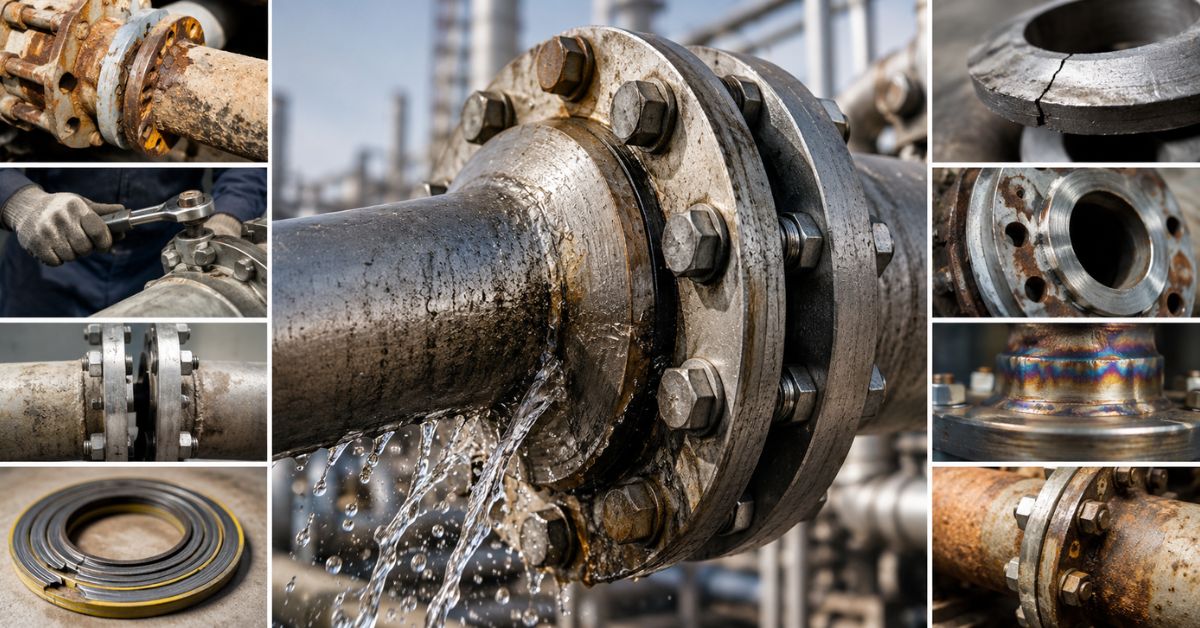
- Visible leakage or weeping at the gasket line, even if minor
- Rust streaks or discoloration around bolt holes and the flange face
- Uneven bolt tension or bolts that appear loose during routine checks
- Vibration or unusual noise at the joint during operation
- Surface pitting or scaling on the flange face
- Gasket extrusion visible at the joint edges
- Cracking near bolt holes, often a sign of over-torquing or fatigue
- Discoloration from overheating, indicating thermal stress beyond rated limits
Preventing Flange Failures Starts with the Right Manufacturer
Most flange failures are preventable with the right combination of material selection, correct installation practice, and manufacturing quality. Working with a manufacturer that follows ASME B16.5 and IS 1538 standards, maintains ISO 9001:2015 certification, and understands your specific industrial application significantly reduces the risk of field failure — and the costs that come with it.
E S HAJI & CO. has been manufacturing custom flanges from 15NB to 3000NB for over 100 years, serving 500+ clients across India and 10+ countries including UAE, Saudi Arabia, Sri Lanka, Africa, and Europe. Our ISO 9001:2015 certified facility in Chennai ensures every flange meets strict dimensional and quality standards before it leaves our plant — helping you avoid the failures that cost time, money, and safety on site.
Need flanges built for reliability, not just compliance? Contact Us for a custom quote.