
Most discussions about straight anchor bolts start in the wrong place. They start with the shape, argue that a bolt without a bend or a plate has nothing to grip the concrete with, and conclude that a straight bar is a cheap substitute for a proper anchor. That conclusion is wrong often enough to be worth unpicking, because on a large number of real connections a plain shank is not a compromise at all. It is the correct answer, and the bent or plated alternative is simply extra cost doing nothing.
The useful question is never is a straight bolt strong enough. It is what is this connection actually resisting, and which load path does the embedded end need to serve”. Get that right and the choice between a straight shank, an L type foundation bolt and a plate type foundation bolt becomes a short conversation instead of a habit.
What a straight anchor bolt actually is
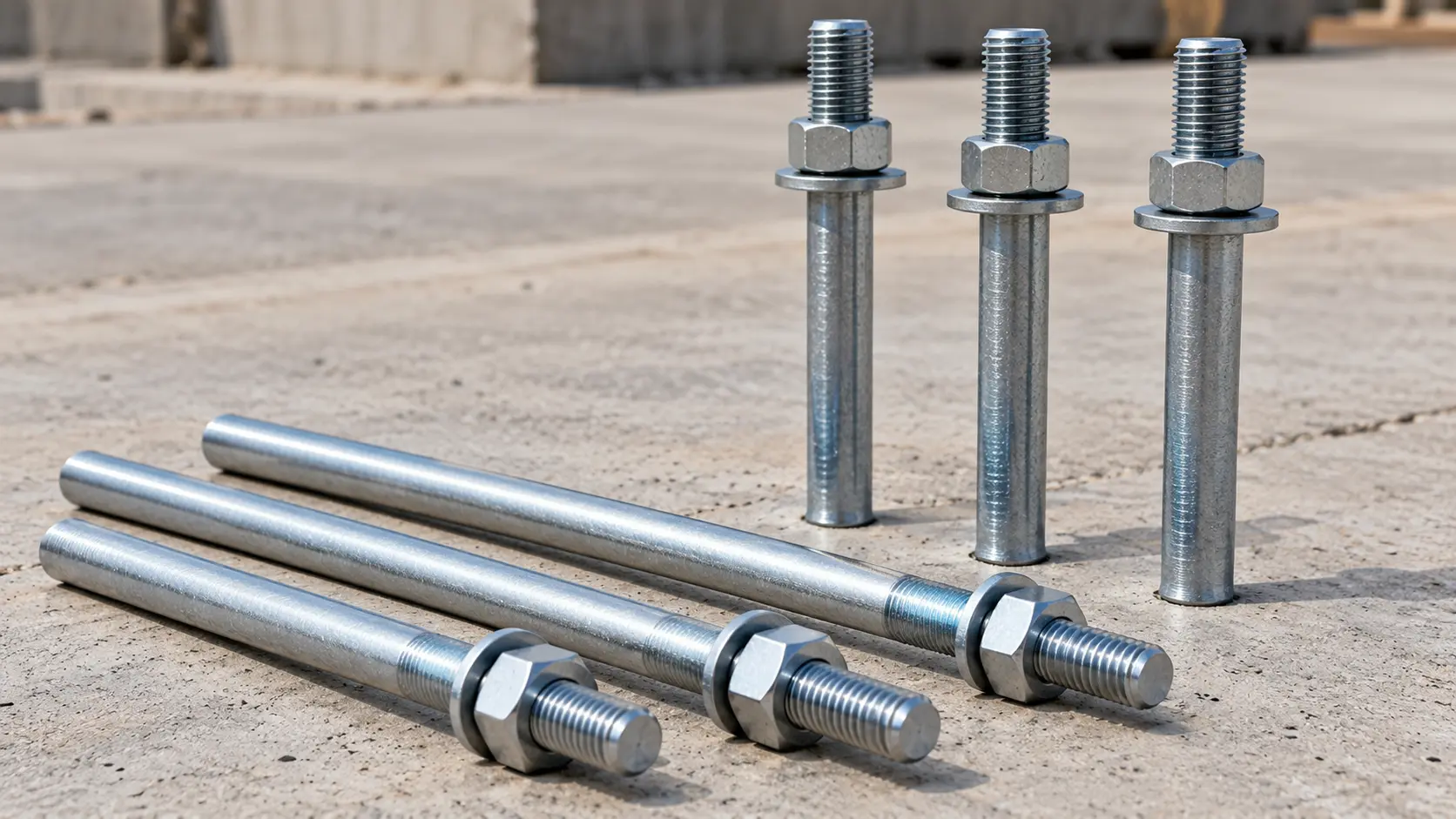
A straight anchor bolt is a plain cylindrical shank, threaded at the projecting end, with no hook, no welded plate and no transverse bar at the buried end. Depending on the design it may be threaded at both ends, or carry a nut and washer assembly at the bottom. Some are cast into the concrete during the pour. Others are installed after the concrete has cured, bonded into a drilled hole with a resin or cementitious grout.
That is the whole description. There is nothing clever about the geometry, and that is precisely the point — the simplicity is what makes straight anchor bolts easier to manufacture accurately, easier to keep vertical in a template, and easier to install without the handling damage a long hooked leg invites.
The three ways any anchor bolt holds in concrete
Before deciding whether a plain shank will do, it helps to be clear about the mechanisms available. There are only three, and most arguments about bolt shape are really arguments about which one is being relied on.
Bond along the shank
Concrete grips the steel surface along the embedded length. Bond is real, but for a smooth round bar it is modest and it degrades under repeated or sustained load. Design codes treat bond in plain bars conservatively for good reason. If a connection depends on bond alone to resist tension, it is a connection worth questioning.
Mechanical bearing at the embedded end
A hook, a welded plate or a nut and washer gives the concrete something solid to push against. The load is no longer shed gradually along the shank; it is delivered to a defined bearing area at depth. This is why T type foundation bolts and plate type bolts behave predictably in tension while a smooth straight bar does not.
Chemical bond from a resin or grout
For post-installed work, an epoxy or polyester resin fills the annulus between a drilled hole and the bar. The adhesive bond across that interface is far stronger than the bond a plain bar develops against cast concrete, which is why a straight threaded stud chemically anchored into cured concrete can carry serious tension even though its geometry is entirely plain.
When a plain shank is enough
Four situations come up repeatedly where straight anchor bolts are the right specification rather than the lazy one.
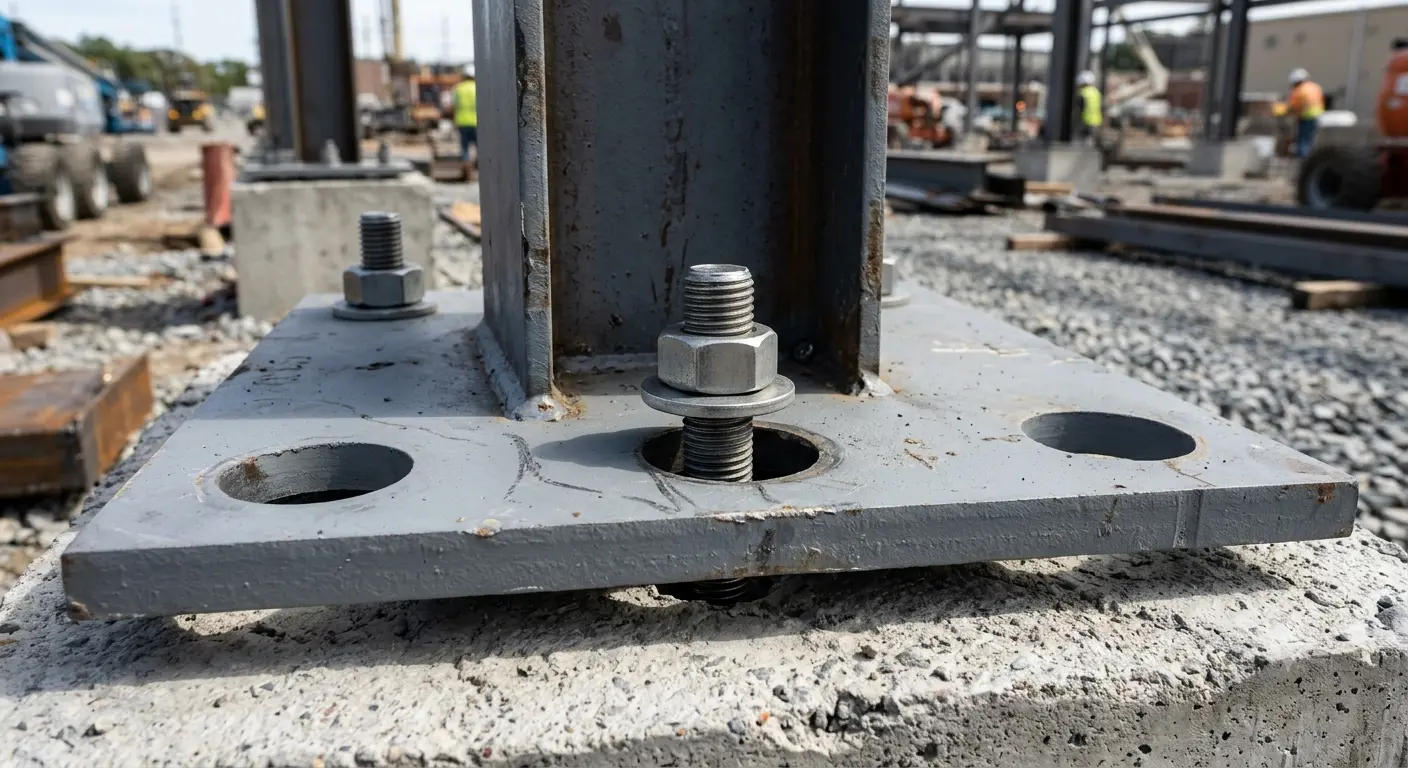
The connection is shear-dominated. When a base plate is resisting horizontal load and the column is in net compression, the bolt is working in shear and the embedded end is not being pulled out of the concrete. A hook contributes nothing here. The things that matter are bolt diameter, edge distance and the quality of the grout bearing under the plate.
The bolt is a locating fixing, not a structural anchor. A great deal of what gets cast into an industrial floor is holding equipment in position rather than restraining it against uplift — guard rails, walkways, light machinery skids, pipe supports. Straight bolts do this job perfectly well and at a lower cost.
The anchorage is post-installed with resin. Chemical anchoring is one of the biggest legitimate uses of straight anchor bolts. The bar has to be straight to go into a drilled hole, and the resin provides the capacity that geometry would otherwise have to provide. Retrofits, machine relocations and corrections to misplaced cast-in bolts all fall here.
A nut and plate washer is fitted at the embedded end. This converts a straight bar into a headed anchor and gives it genuine bearing at depth. It is arguably the cleanest anchor there is, and it is covered properly in its own section below.
When a straight anchor bolt is the wrong choice
Being even-handed about this matters more than defending the product. A plain shank relying on bond alone should not be used where there is sustained or cyclic tension, where the equipment vibrates, where uplift governs the design, or where the structure is slender and wind-sensitive. A tall light pole or a sign gantry is a tension problem before it is anything else, which is why light pole foundation bolts are supplied with a defined bearing arrangement rather than as plain bars.
The failure mode is the thing to understand. A bonded plain bar under sustained tension does not snap. It creeps out of the concrete slowly, leaving the foundation visually intact, and the first symptom is usually a base plate that has lifted a few millimetres and a grout bed that has started to crack around the edge. By then the connection has already lost a large part of its stiffness.
Straight anchor bolts with a nut and plate at the embedded end
This arrangement deserves more attention than it gets in Indian practice, where the hooked bolt remains the default. A straight bar with a heavy hex nut and a plate washer tightened at the buried end gives you bearing over a known area, in a known plane, with no weld to inspect and no hook geometry to get wrong in the shop.
It also behaves better in a congested rebar cage. A long hooked leg has to be threaded past reinforcement and often ends up bent slightly out of plane to make it fit, which quietly changes the bearing geometry the designer assumed. A straight shank drops in cleanly. For retrofit and equipment work on existing slabs we see the same preference, often alongside structural fabrication items that have to be set out from the same template.
The one thing to insist on is that the bottom nut is properly tightened and, where the drawing requires it, tack welded or double-nutted so it cannot back off during the pour or during vibration of the concrete.
What to specify when you order straight anchor bolts
Diameter and length are the two things every enquiry contains and the two things that are least sufficient on their own. A complete specification for straight anchor bolts should state:
- Property class or grade — a 4.6 and an 8.8 of the same diameter look identical and behave entirely differently under load
- Total length and projection above finished concrete level, separately, so thread length can be set correctly
- Thread length and whether both ends are threaded
- Embedded-end arrangement — plain, or nut and plate washer, and whether the nut is to be welded
- Finish — self colour, hot dip galvanised or stainless, which depends on exposure far more than on load
- Nuts and washers required, including the count per bolt, since a levelling nut arrangement needs more than one
Where the bolts are part of a group under a base plate, the template drawing matters as much as the bolt drawing. A perfectly made set of bolts in the wrong pattern is scrap, and in our experience across the foundation and anchor bolt range that is a more common cause of rework than anything to do with the bolt itself.
The substitution to watch for
The genuine problem with straight anchor bolts is not the product. It is substitution without a design decision behind it. A fabricator short of time has round bar in stock, the drawing calls for a hooked bolt, and straight bars go in because they can be made in an afternoon. Nobody records the change, and the connection has silently moved from bearing to bond.
If straight bolts are the right answer for a connection, specify them deliberately, state the embedded-end arrangement, and keep the reasoning on the drawing. If they are being chosen because they are quicker to make, that is a different situation and the engineer needs to know about it before the pour, not afterwards.
FAQs:-
Can straight anchor bolts be used in tension?
Yes, provided the tension is carried by something other than bond along a smooth shank — a nut and plate washer at the embedded end, or a resin anchorage in a drilled hole. A plain bar cast into concrete and relying on bond alone is not a sound tension anchor for sustained or cyclic load.
Are straight anchor bolts weaker than L bolts?
Not in the bar itself. The steel section and grade determine tensile and shear capacity, and those are identical for the same diameter and class. The difference is entirely in how the embedded end transfers load into the concrete.
Is a threaded rod the same as a straight anchor bolt?
Functionally they overlap. A fully threaded rod is one form of straight anchor, common in chemical anchoring. A manufactured straight anchor bolt is usually threaded only over the projecting length, which leaves a plain shank through the shear plane and is generally preferable where shear is significant.
Can straight anchor bolts be galvanised?
Yes. Hot dip galvanising is standard for exposed and coastal applications. Threads need to be cut or chased to allow for the coating thickness, so the finish has to be stated at the time of order rather than arranged afterwards.
What embedment depth do straight anchor bolts need?
That comes from the structural design — the applied tension and shear, the concrete grade, the edge distance and the spacing between bolts in the group. There is no general figure that is safe to quote, and any supplier offering one without seeing the loads is guessing.