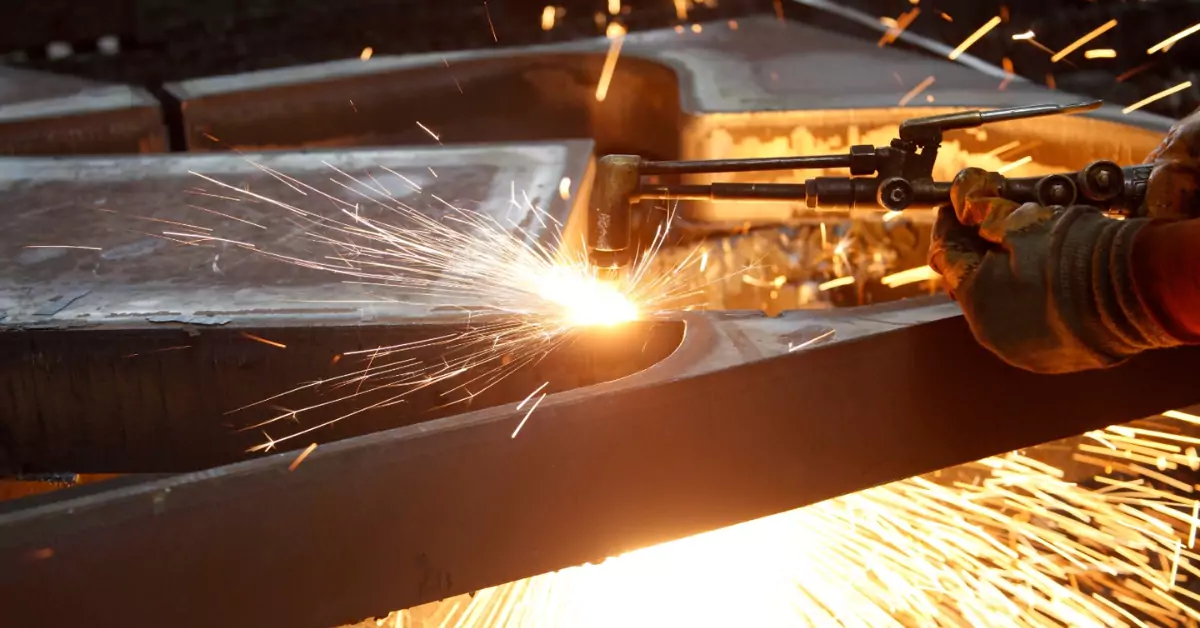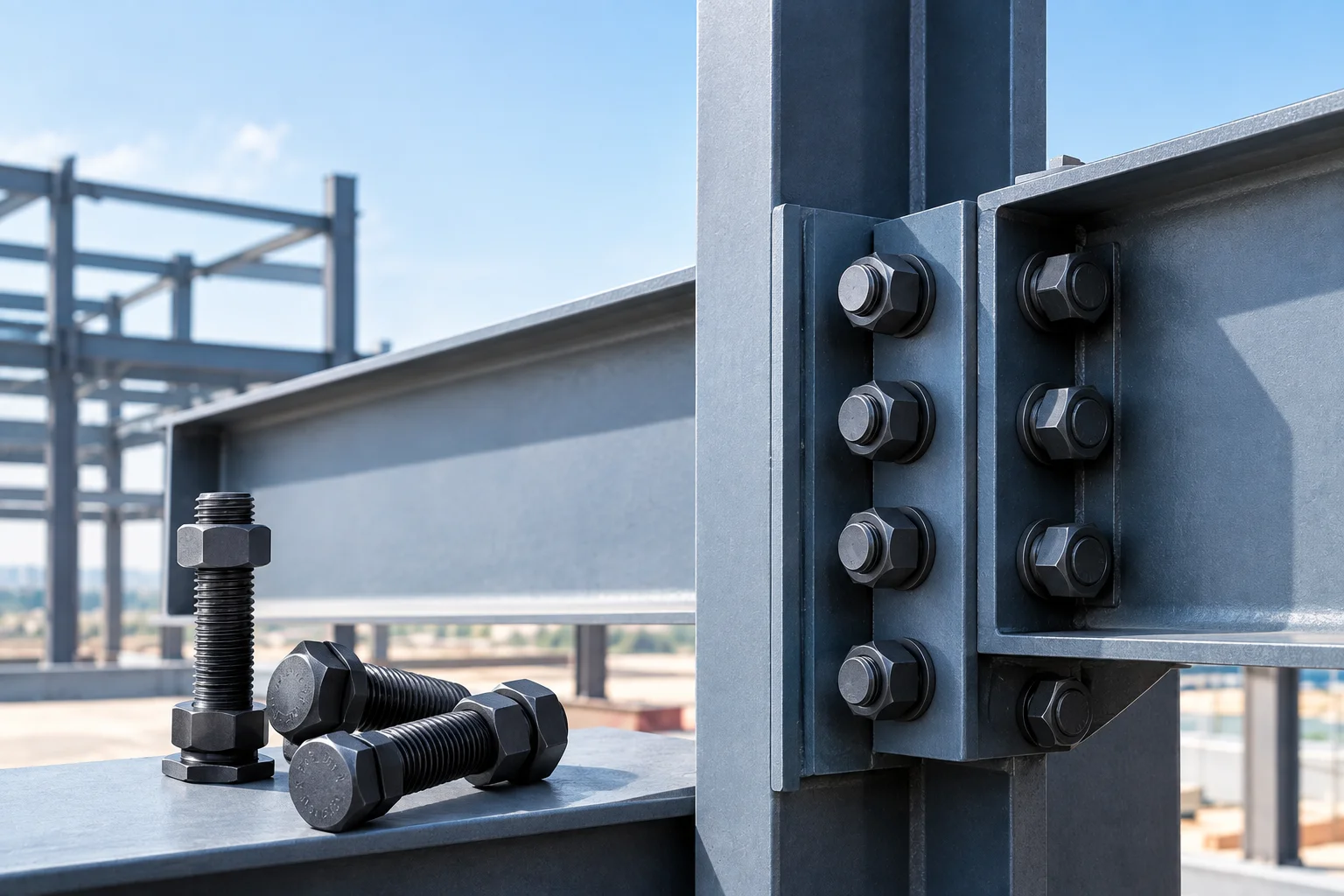

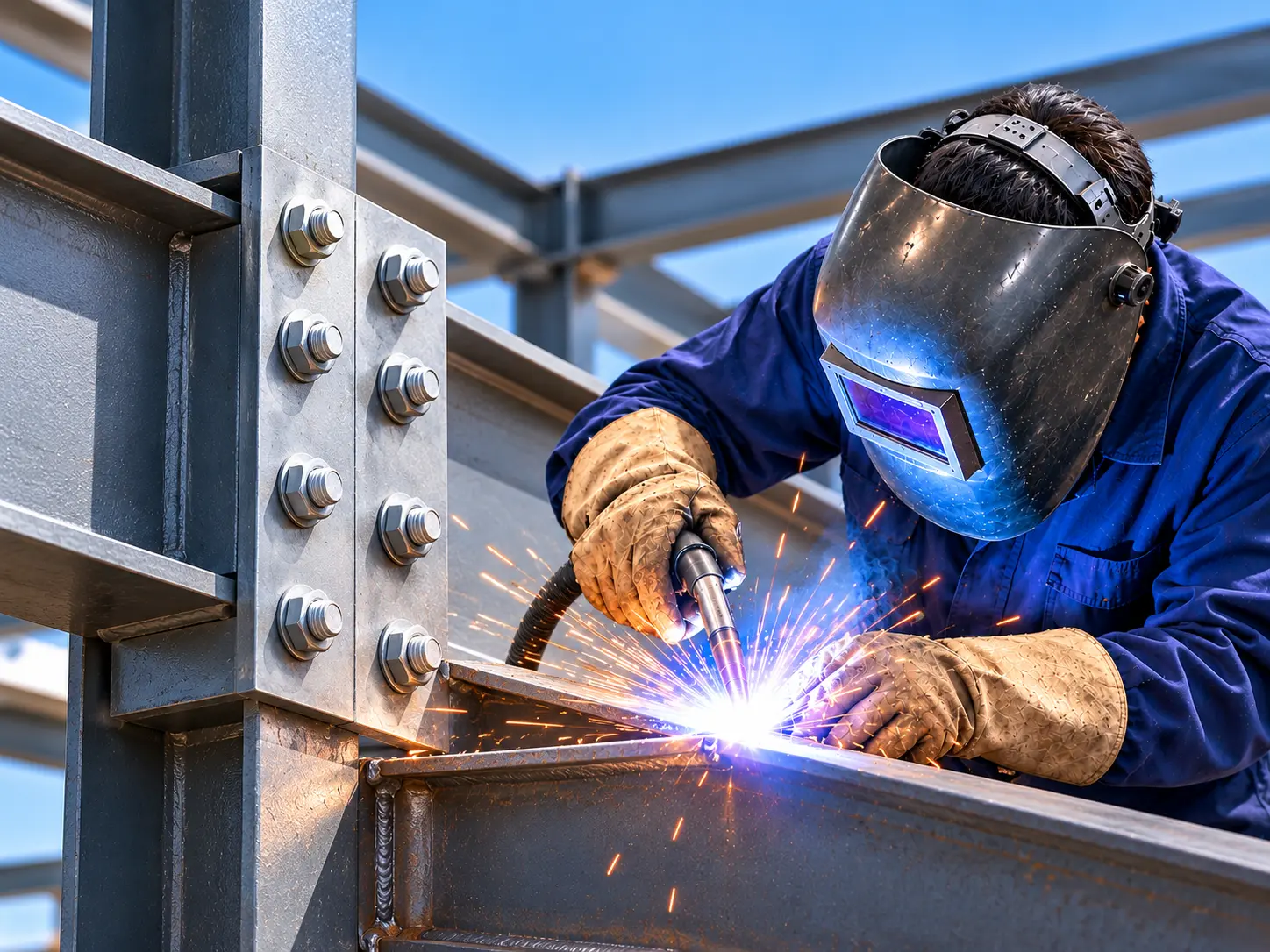
The bolted vs welded question gets argued as though one method is simply better than the other. It is not that kind of decision. Both make perfectly sound connections, both are used on serious structures every day, and the right answer changes depending on where the joint is, who is assembling it, what the weather is doing and what has to happen after the steel is up.
What follows is how the choice is actually made in practice, rather than a list of advantages. If you are specifying a structural fabrication package, this is the decision that quietly sets your erection programme, your inspection cost and how much your foundation and anchor bolt order is going to matter.
The rule most fabricators already work to
Before weighing anything up, there is a default worth knowing: weld in the shop, bolt on site.
A workshop has flat floors, overhead cranes, positioners, power, shelter and welders working in comfortable positions. The same weld made in a shop and made forty feet up in the wind are not the same weld, and they do not cost anything like the same money. So most fabricators build as much as they can into shop-welded assemblies, then join those assemblies on site with bolts. Put plainly, the bolted vs welded choice is usually a question about site work, not about shop work.
That default answers the bolted vs welded question for a large share of ordinary buildings before anyone sits down to think about it. The interesting cases are the ones where it does not apply.
Bolted vs welded: where bolting wins
Speed and sequence
A bolted connection carries load the moment it is made up. There is no cooling, no inspection hold, no waiting. A crew can land a member, bolt it, release the crane and move on. On a tight erection programme this is usually the single biggest argument in the bolted vs welded comparison, because crane time is expensive and idle crane time is worse.
Inspection is simpler and cheaper
Checking a bolted joint is largely visual, plus tightening records where pre-tensioned bolts are used. Checking a welded joint properly can mean dye penetrant, magnetic particle or ultrasonic testing depending on the weld category, and that means a qualified technician on site with equipment. On a structure with hundreds of site joints, the inspection bill alone can decide the question.
No hot work
In an operating plant, a refinery, a tank farm or anywhere with a flammable inventory, welding needs a hot work permit, gas testing, a fire watch and often a shutdown of adjacent operations. Bolting needs none of that. For brownfield and maintenance work this frequently settles the matter on its own.
Weather and site conditions
Welding needs protection from wind and rain, a power supply and access around the joint. Bolting carries on in conditions that would stop a welder, which matters a great deal if the programme runs through a monsoon.
It can be undone
Bolted structures can be dismantled, modified, extended or relocated. Conveyor galleries, plant platforms, equipment supports and anything likely to be altered later are better bolted, and the saving appears years after the original job.
Bolted vs welded: where welding wins
It forgives dimensional error
This is the advantage people forget. A bolted connection needs holes that line up, which means accuracy in the shop and accurate setting out on site. A welded connection can absorb a few millimetres of misfit that would otherwise stop a bolted joint dead. Where tolerances are genuinely difficult, welding can rescue a situation that bolting cannot.
Continuity and stiffness
A full penetration welded joint transmits moment with the same continuity as the parent section, with no slip and no additional plates. Bolted moment connections are entirely possible using end plates and pre-tensioned bolts, but they involve more parts and more thickness. Where the frame depends on rigid joints, welding often produces the cleaner solution.
Fewer parts, less congestion
A welded connection has no cleats, no splice plates, no packs and no bolt groups. In a congested node where several members meet, that absence is worth a lot — both for fit and for appearance on exposed steelwork, and it is one of the few places where bolted vs welded is decided on geometry alone.
No crevices
Faying surfaces and bolt holes are crevices, and crevices hold moisture. In an aggressive or coastal environment a continuously welded and sealed joint has a real durability advantage over a bolted one, provided the weld itself is properly coated afterwards. In marine and chemical environments this can outweigh every speed argument on the bolted vs welded list.
The combination most jobs actually use
In practice the honest answer to bolted vs welded on most projects is both, deliberately divided. Shop-welded assemblies, bolted site splices, and site welding reserved for the few joints that genuinely need continuity or where fit cannot be guaranteed.
Where a structure is to be hot dip galvanised, that division gets firmer still. Galvanising happens after fabrication, so anything welded on site burns the coating off locally and needs repair by hand, which is never as good as the original. Bolted site connections let each piece be galvanised whole and arrive finished.
Fatigue is the other case worth separating out. Welded details carry stress concentrations that matter under cyclic load, while properly pre-tensioned friction grip bolting does not slip and behaves well in fatigue. For crane gantries, machinery supports and anything with load reversal, that difference is a design decision rather than a preference.
Where the money actually goes
The cost comparison surprises people because the obvious numbers are the small ones.
Bolts, nuts and washers cost money, and a large bolted job buys a lot of them. But welding consumables are not free either, and that is not where the difference sits. The difference is labour, access and time. A certified welder working at height with staging, protection, power and an inspector costs a great deal more per joint than two erectors with impact wrenches, and the programme implications multiply that.
Which is why comparing a bolted and a welded scheme on material cost alone gives the wrong answer almost every time. The question is not what the connection is made of, it is how many hours of skilled site labour it takes to make and verify. Price a bolted vs welded scheme that way and the comparison usually reverses.
What this means when you order
Once the bolted vs welded split is decided, it determines what you actually need to buy. A bolted scheme means a full bolt schedule — diameters, grades, lengths, and the right nut and washer count for each connection type, with pre-tensioned assemblies identified separately from ordinary bearing connections. A welded scheme means more attention to shop fit-up, weld procedures and inspection.
It also reaches the foundations. Column bases are the one place where bolting is effectively compulsory, because you cannot weld to a cast-in bar with any confidence about what is happening below the concrete. So whatever the frame above does, the base still needs properly specified anchor bolts, template plates and the correct washers — which is where a steel fabrication package and a bolt order meet. Whether the base calls for L type foundation bolts or plate type foundation bolts, that part of the structure is bolted regardless of what the frame above it does.
Frequently asked questions
Is a welded connection stronger than a bolted one?
Not inherently. Both are designed to carry the required load, and a correctly designed bolted connection is as capable as a welded one. Strength is a design outcome, not a property of the method. The differences are in stiffness, tolerance, inspection and the practicality of making the joint where it has to be made.
Why do most structures use bolts on site rather than welding?
Because shop conditions produce better welds more cheaply than site conditions, and because bolted joints are quick, weather-tolerant and simple to inspect. Most fabricators therefore weld in the shop and bolt on site wherever the design allows it.
When should the bolted vs welded decision be made?
During detailing, not during erection. Connections designed for bolting from the start can usually eliminate site welding almost entirely, but converting a welded scheme to a bolted one late in a project means redesigning joints and reordering steel. Settle the bolted vs welded split early and the rest of the package follows from it.
Which is better for galvanised steelwork?
Bolting. Galvanising is applied after fabrication, so site welding destroys the coating locally and the repair is never equal to the original. Bolted site connections allow each member to be galvanised complete.
Does bolted vs welded change under vibration or load reversal?
Pre-tensioned friction grip bolting handles cyclic load and reversal well because the joint does not slip. Welded details can be fatigue sensitive depending on the detail category. For crane gantries and machinery supports this is a design decision and should come from the engineer, not from site preference.