
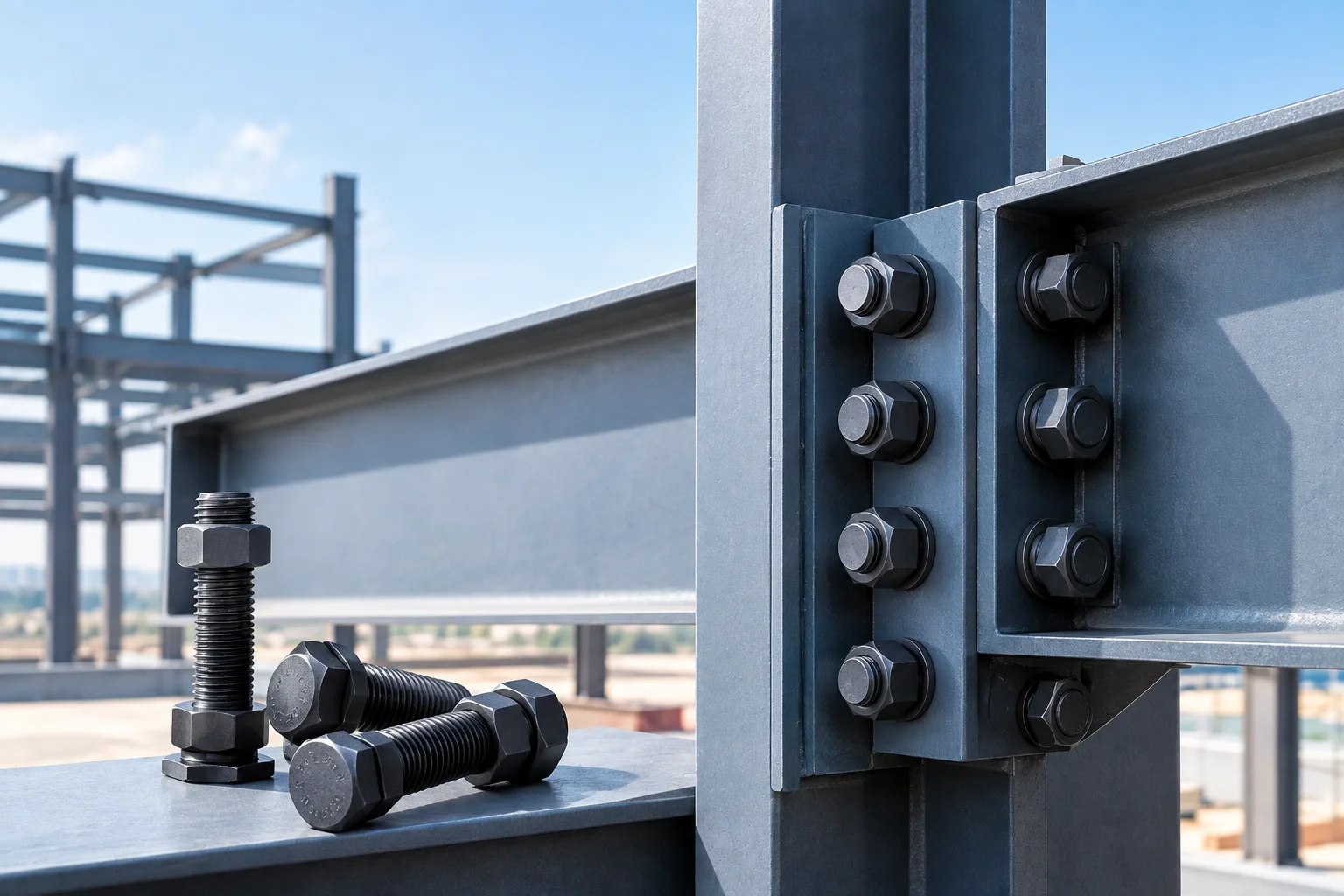
Most bolted connections work by bearing. Load pushes the plates, the plates push the bolt shank, and the bolt resists in shear. It’s simple, it’s economical, and for the majority of structural steel fabrication work it’s entirely adequate.
High Strength Friction Grip bolting does something different, and the difference is worth understanding — because the most common HSFG failure on Indian sites isn’t a bolt breaking. It’s a connection that was never actually an HSFG connection in the first place.
Most of that comes down to procurement rather than design. The bolt gets specified correctly, and then the structural connection fasteners around it — the nut, the washer — get treated as commodity items.
How a friction grip joint carries load
An HSFG bolt is tightened to a high proportion of its proof load. That tension clamps the plates together hard, and the friction generated across the contact surfaces — the faying surfaces — resists the applied shear.
The consequence is the important part: because the plates never slide, the bolt shank does not experience shear or bearing stress, which makes the joint far more resistant to fatigue and vibration. There is no slip at service load, so there is no repeated micro-movement working the connection loose over years of cyclic loading.
That is why HSFG bolting is specified for bridges, crane runways, transmission towers, metro steelwork and anywhere fatigue governs. It isn’t a stronger bolt doing the same job. It’s a different load path.
The four standards, and what each one covers
This is where specifications go wrong, because engineers often write “HSFG bolts to IS 3757” and stop. IS 3757 is one document in a set of four.
| Standard | Governs |
|---|---|
| IS 3757 | High strength structural bolts — the bolt itself |
| IS 6623 | High strength structural nuts |
| IS 6649 | Hardened and tempered washers for high strength bolts and nuts |
| IS 4000 | Code of practice for high strength bolting in steel structures — design and installation |
IS 4000 is the companion that ties them together, and it is explicit that bolts, nuts and washers shall conform to IS 3757, IS 6623 and IS 6649 respectively. IS 800 governs the connection design, and IS 1367 Part 3 covers fastener mechanical properties.
IS 4000 permits two property classes for friction grip connections — 8.8 and 10.9 — and bolts must conform to IS 3757. A property class of 8.8 means a nominal ultimate tensile strength of 800 N/mm² with a lower yield stress of 80% of that figure.
The mistake that quietly destroys the connection
An HSFG joint only works if the nut can develop the bolt’s proof tension without stripping. That requires a high strength nut of a compatible property class — not a nut from the site store. Substitute an ordinary commercial nut and the threads yield before the bolt reaches design tension. The connection looks bolted. It has washers, it has torque marks, it passed a visual inspection. And it is under-clamped, which means it will slip.
The practical discipline is straightforward: procure and certify the bolt, nut and washer as a matched assembly, not as three line items filled from whatever is in stock. Then tension by a defined method under IS 4000 — turn-of-nut, calibrated torque, or load-indicating washers — with the tensioning witnessed and recorded.
The hardened washer isn’t optional either. Without it, the high preload causes the nut or bolt head to bite into the structural steel, and the preload you carefully applied bleeds away as the steel deforms locally.
Faying surface preparation is a structural parameter
The joint’s capacity depends on the slip factor of the contact surfaces, so surface condition is a structural parameter rather than a finishing detail. Mill scale, loose paint, oil and grease all reduce it. IS 4000 includes a standard test for evaluating slip factor precisely because this cannot be assumed.
If the connection is going to be painted, the faying surfaces are masked or the paint system is specifically qualified for slip-critical use. A coat of primer applied across a splice plate before assembly can turn a designed friction grip connection into something considerably weaker.
When HSFG is the right specification and when it isn’t
Specify friction grip when
- Fatigue or dynamic loading governs – bridges, crane girders, vibrating machinery supports
- No slip is permissible at service load
- The connection is in a seismically active zone and slip would redistribute forces unpredictably
- Joint rigidity is assumed in the structural analysis
Ordinary bearing-type bolting is adequate when
- Loading is predominantly static
- Small controlled slip is tolerable
- The connection is a secondary member with no fatigue exposure
Over-specifying HSFG on routine static connections adds cost in fasteners, in installation labour, and in inspection — without buying performance the structure needs. Under-specifying it on a fatigue-loaded joint is a different category of problem entirely.
Sizes and finishes in general use
HSFG assemblies are commonly supplied in property classes 8.8 and 10.9. For railway bridge work, Indian Railways guidelines cover sizes M16 to M36 for friction type joints under the IRS Steel Bridge Code — and note that galvanised bolts are not covered by those particular guidelines, which is worth knowing before specifying hot-dip galvanising for a railway application.
Finishes in general use include black oiled, phosphated and hot-dip galvanised. Galvanising changes the friction condition at the thread, so the tensioning method has to account for it — you cannot simply apply the torque figure that worked for a black bolt.
Specifying it properly: a seven-point checklist
- Diameter and length, with grip length calculated per IS 4000 Table 1 allowances
- Property class — 8.8 or 10.9
- Bolt to IS 3757, nut to IS 6623, washer to IS 6649, supplied as a matched set
- Finish, and the tensioning method appropriate to it
- Faying surface treatment and the assumed slip factor
- Tensioning method under IS 4000 and the verification required
- Test certification per batch — chemistry, mechanical properties, hardness, traceability
That last point is the one buyers most often skip and most often regret. A certificate that ties a specific batch of bolts to specific test results is the difference between a documented connection and an assumed one.
The same logic applies across the wider connection package. On a pre-engineered building, the anchors, brace rods, brace rod connectors, sag rods and hillside washers all carry load, and all benefit from the same traceability discipline as the structural bolts.
Frequently asked questions
Are HSFG bolts and high tensile bolts the same thing?
Not quite. High tensile refers to the bolt’s material strength — property class 8.8, 10.9 or 12.9. HSFG refers to how the connection works: a preloaded, friction-transferring joint. HSFG bolting uses high tensile bolts, but fitting a high tensile bolt into a connection doesn’t make it friction grip. The preload and the matched assembly do.
What is the difference between a friction grip and a bearing-type connection?
In a bearing-type connection the plates are allowed to slip until they bear against the bolt shank, and the bolt then resists in shear. In a friction grip connection the bolt is preloaded so the plates clamp together and transfer load by friction, with no slip at service load. Same bolt, fundamentally different load path.
Can HSFG bolts be reused?
Generally no. The bolt has been tensioned close to its proof load and has undergone permanent deformation. Reuse is a false economy on a connection where failure is structural.
Why do the nuts and washers have separate standards?
Because each component has to perform under the preload. The nut must develop the bolt’s tension without thread stripping, and the washer must distribute that load without embedding into the parent steel. Three matched components, three specifications — IS 3757, IS 6623 and IS 6649.
Do galvanised HSFG bolts need a different tightening method?
The tensioning approach has to account for the coating, because galvanising changes the friction condition at the thread. A torque value calibrated for a black oiled bolt will not produce the same tension in a galvanised one. Follow the method specified for the assembly type rather than carrying a figure across from a different finish.
How is HSFG bolt tension verified on site?
IS 4000 sets out defined methods — turn-of-nut, calibrated wrench, and load-indicating or direct tension indicator washers. Whichever is specified, the tensioning should be witnessed and recorded. Visual inspection alone cannot confirm that a bolt reached its design tension.
What documentation should come with structural bolt assemblies?
A batch certificate covering chemistry, mechanical properties, hardness and traceability. At E S HAJI & CO a Mill Test Certificate is issued with every batch as standard, so the material in a connection can be traced back to its test results rather than assumed